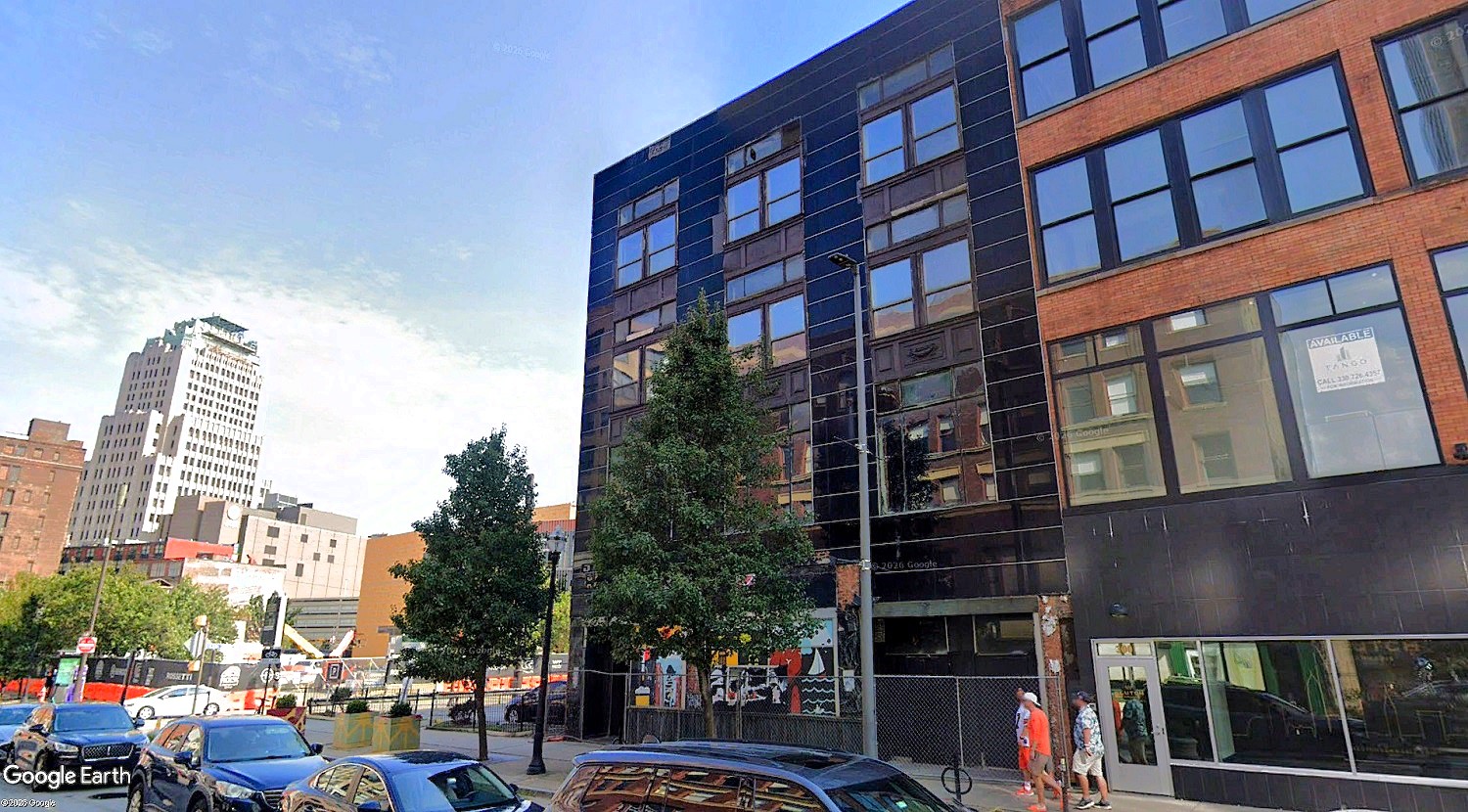
With Bedrock Real Estate’s Rock Block under construction in the background, another developer is seeking to demolish the dark building in the foreground — 310 Prospect Ave. (Google). CLICK IMAGES TO ENLARGE THEM.
Nationally registered, next to Rock Block
Smaller buildings aren’t getting the breaks in Downtown Cleveland lately. Doesn’t matter if they’re historic or not. NEOtrans has been writing lately about the 143-year-old Gilman Building facing its demise for a mixed-use development in the Warehouse Distrct.
A newer building, the 1963-built Walter G. Whitlatch Building, 1910 Carnegie Ave., was acquired in June by the Ohio Department of Transportation. It submitted a demolition permit yesterday to the city so the building could be demolished for the Inner Belt highway’s Central Interchange redesign.
And, in another homage to the almighty car, the Herold Building, 310 Prospect Ave., faces its end, too. Its apparent replacement? An interim parking lot until its owner, J-Dek Investments Ltd. of suburban Solon, figures out what to do with its 0.2-acre site.
At J-Dek’s request, C&J Contractors Inc. of Cleveland submitted a demolition application to the city on Oct. 30. Cost of the demolition is estimated at $410,858. A separate permit application is needed to cut away the building from its neighbor, the former Record Rendezvous, 300 Prospect.
That site already includes a neighboring parking lot at 320 Prospect. Here, at the corner of East 4th Street, is where a six-story building stood until 1996 when it was heavily damaged by fire.
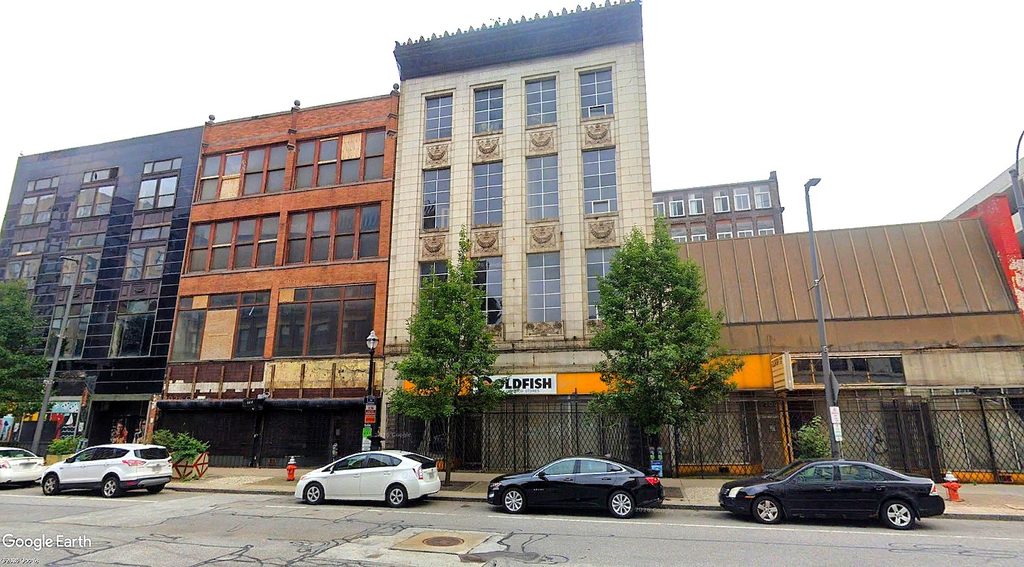
For more than two decades, these four historic buildings have been left to rot. Only the former Record Rendezvous building, second from the Herold Building at left, was renovated since this 2024 streetview. The terra cotta-covered Kendel Building is next, followed by 202 Prospect that dates to 1850, city records show (Google).
The difference with the Herold is that this four-story, 15,720-square-foot building, is on the National Register of Historic Places, as are two neighbors — the ex-Record Rendezvous and the Kendel Building, 210 Prospect. In fact, its entire neighborhood, Lower Prospect-Huron Historic District, is on the National Register.
While the building that had the famed Record Rendezvous was renovated last year with a Klutch Cannabis store and the Kendel, dubbed the Goldfish building, are structurally sound, the Herold Building was condemned by the city in 2010 and has remained neglected since.
And development is happening nearby. Between Prospect and Huron, on the other side of East 4th, Detroit-based Bedrock Real Estate is developing the Rock Block with a Cosm immersive experience venue, a 550-space parking garage over retail, and a small mixed-use building.
Cleveland-based Stark Enterprises and its partner J-Dek Investments previously owned the Rock Block, plus 310 and 320 Prospect until 2022. The Rock Block is where Stark planned to build the $350+ million nuCLEus development. The nuCLEus site was sold to Bedrock and the LLCs that owned the Prospect properties were transferred to J-Dek.
NEOtrans sent an e-mail to J-Dek President Elliott Jacobs seeking comment and more information but has yet to hear back from him.
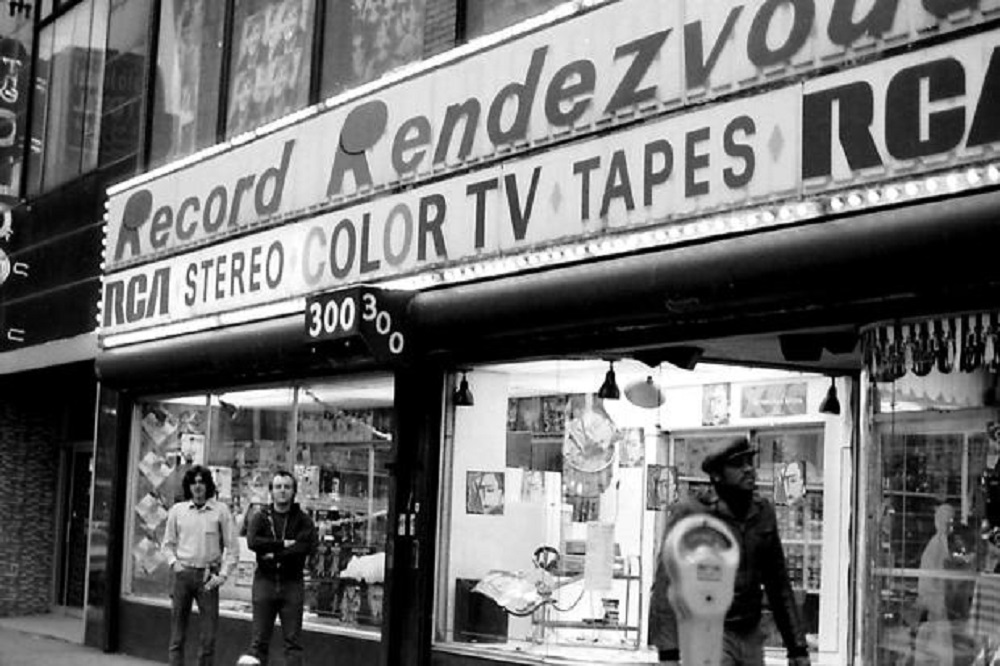
Not many people took pictures of the Herold Building at far left and its longest-lasting tenant, Kurtz Furniture, when the Record Rendezvous store was next door — one of the few places anyone could buy rock-n-roll records in the 1950s. This was the scene on Prospect Avenue circa 1980 (Klutch Cannabis).
During the ownership by Stark/J-Dek, 310 and 320 Prospect were difficult nuts to crack, said Rico Pietro, a principal at the Independence-based commercial real estate brokerage Cushman & Wakefield | CRESCO.
Pietro’s job for nearly a decade was to market Stark/J-Dek properties to end users. While he can’t speak to what Bedrock and J-Dek plan are planning to do with their sites now, he can cite his recent experiences with the Prospect properties.
“The thought pattern is, as soon as the Rock Block site gets developed, which has now commenced, that the viability and value of that (Prosect/East 4th) corner explodes,” he told NEOtrans. “Right now, macro market conditions are new construction is challenging anywhere, and exasperated in the downtown market.”
He noted that developers a decade ago would have jumped at redeveloping the Prospect properties if there was a first-tier tenant waiting in the wings, like a Starbucks or as a Ruth’s Chris Steak House had considered the Prospect site until it went to 200 Public Square before closing. Today, that’s even more challenging.
“Right now, with interest rates where they are and construction cost doubling over the last decade, the juice is not always worth the squeeze, even with a first-tier retailer,” he said. “This is why an intermediate use as parking makes a lot of sense until market conditions improve allowing for the developer and the market to get the project the visibility of the site it deserves.”
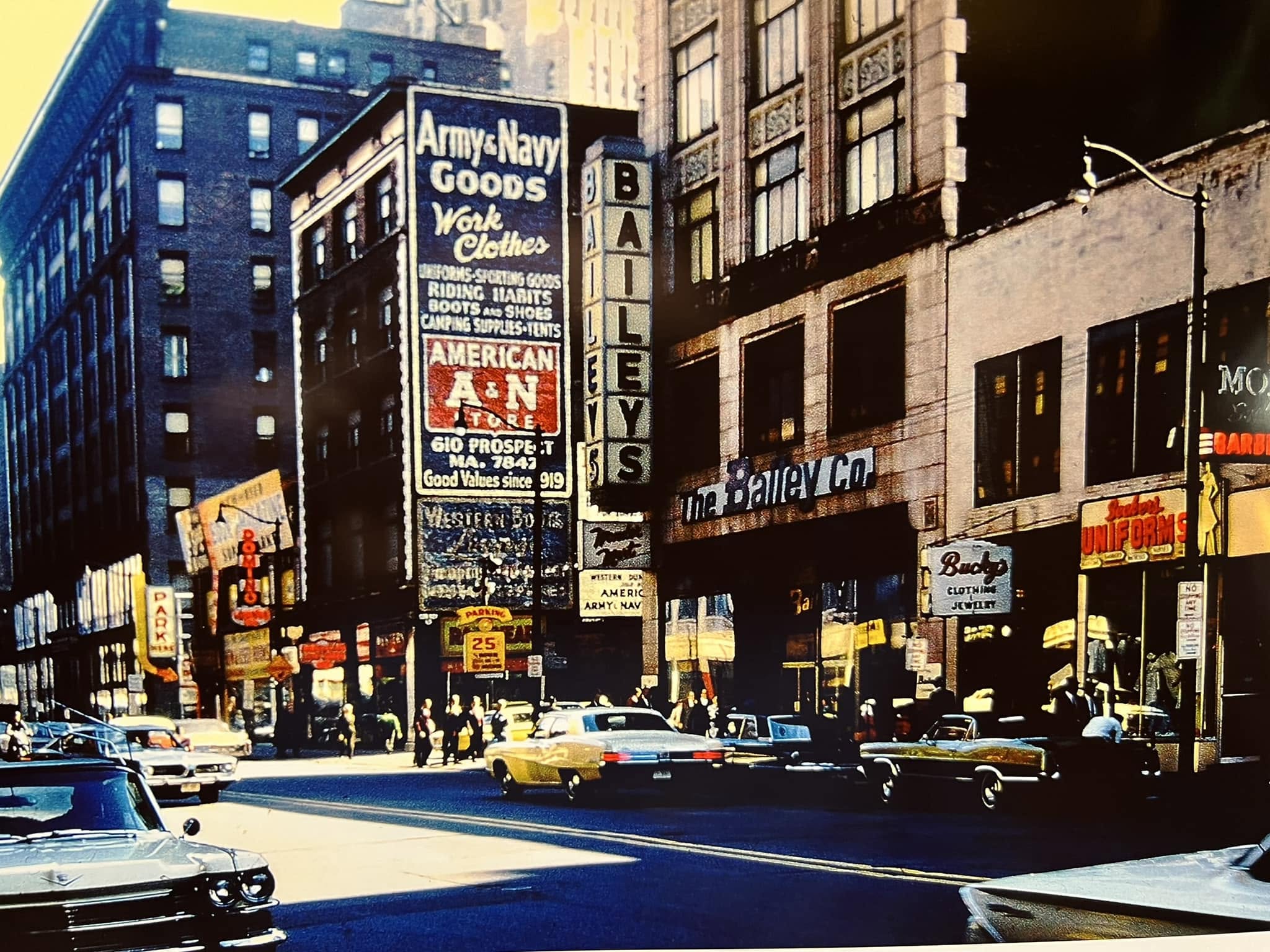
In 1968, the 600 block of Prospect Avenue was still a bustling place but gritty. And after dark it was not safe. The only building still standing this view looking east is The Electric Building, 700 Prospect, at far left (contributed).
In 2014, Stark Enterprises acquired from Los Angeles-based L&R Group of Companies two groups of downtown properties for $26 million. One was a 2.33-acre parking crater at West 9th Street and St. Clair Avenue in the Warehouse District. Stark sold that swath of parking in July.
The other was 2.3 acres of land that included the nuCLEus site and the Prospect properties. J-Dek joined Stark in a partnership called Gateway Huron LLC in acquiring most of these properties.
L&R sought to demolish the vacant, condemned Herold Building but the city denied its request. L&R appealed to Cuyahoga County Common Pleas Court but sold the Herold while its case was pending. The case was withdrawn when Stark acquired the Herold.
Stark pledged to renovate the Herold, only to change its mind after five more years of structural decay. Stark and its demolition contractor requested approval in 2019 from the Downtown-Flats Design Review Advisory Committee to raze the Herold.
It was tabled until Stark could present a post-demolition site plan. Stark returned with a proposal for a grassy lot. It was rejected. Stark said it would cost $6 million to address the Herold’s many code violations and remove the Herold Building’s condemnation.
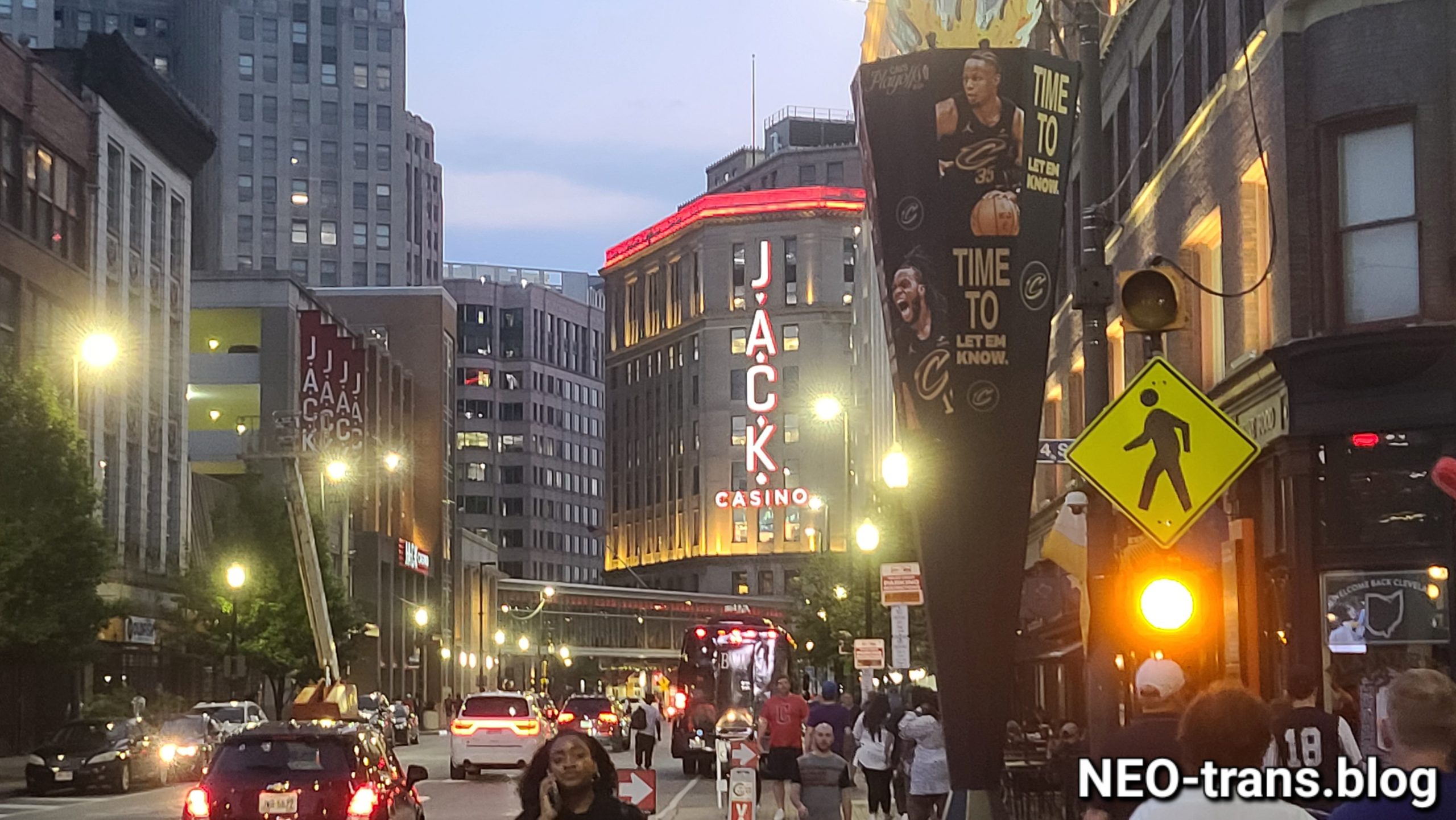
Prospect Avenue is often busy in the evenings whenever there is a game or other event at the Gateway complex located just one block south and will get busier with Cosm’s opening next year (NEOtrans).
Stark proposed rebuilding and dramatically expanding the Herold as a 60,000-square-foot Class A office building by adding four more floors, including new structural supports through the Herold and widening it onto the adjacent lot at 320 Prospect.
The dramatic changes might have negated Stark’s ability to win historic tax credits. Stark apparently didn’t pursue them, and instead let the building sit. It has since been fenced off.
Buildings that are 120 years old have a story to tell and this one is no different. The Herold Building was constructed in 1906 and expanded in 1908 to 300 Prospect by Oscar and A. B. Herold, owners of a Herold Brothers barber supply store on Public Square.
The Herold housed the American Federation of Labor headquarters over Wilson’s bird store and then the Pilsener Brewing Co., according to its 2013 landmark registration.
Kurtz Furniture acquired the Herold in 1920 and modernized the facade with structural glass panels in 1948. Kurtz closed its downtown store in the 1970s. The building since housed two ground-floor restaurants — the Clock Restaurant and Downtown Eddie’s — but the upper floors have remained largely vacant for decades.
END