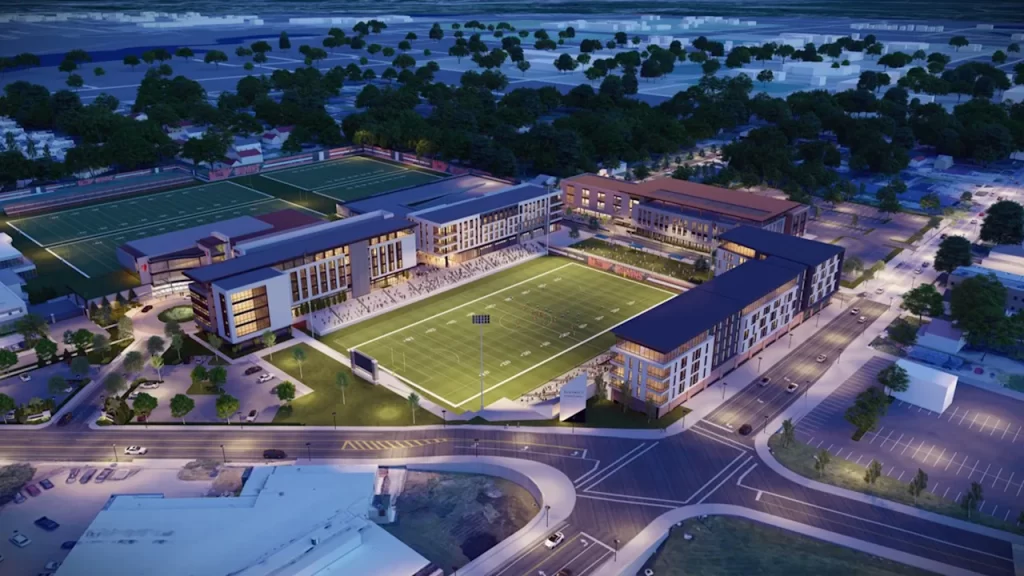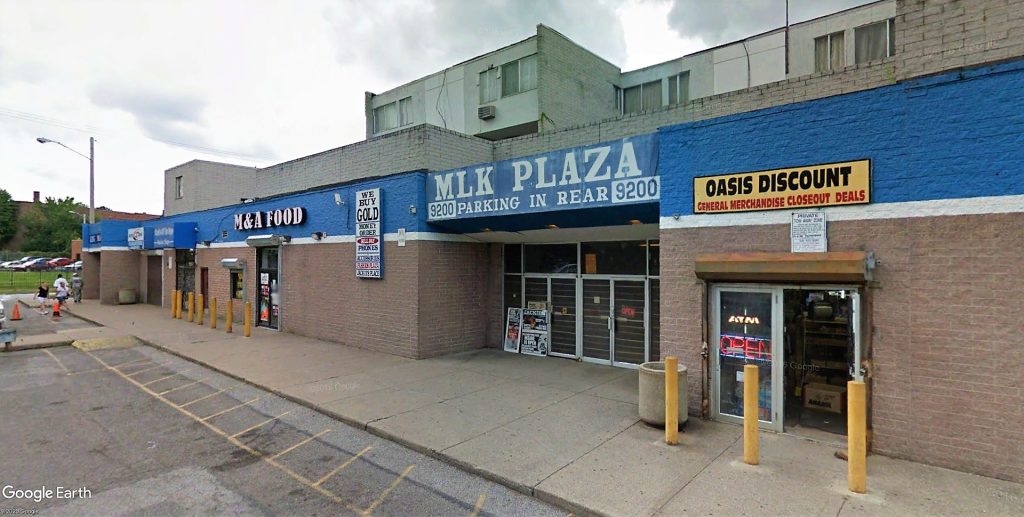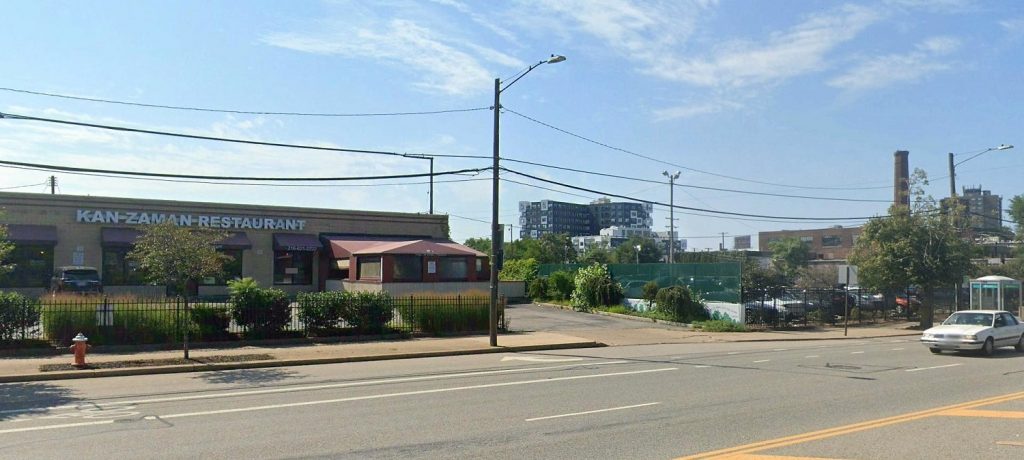
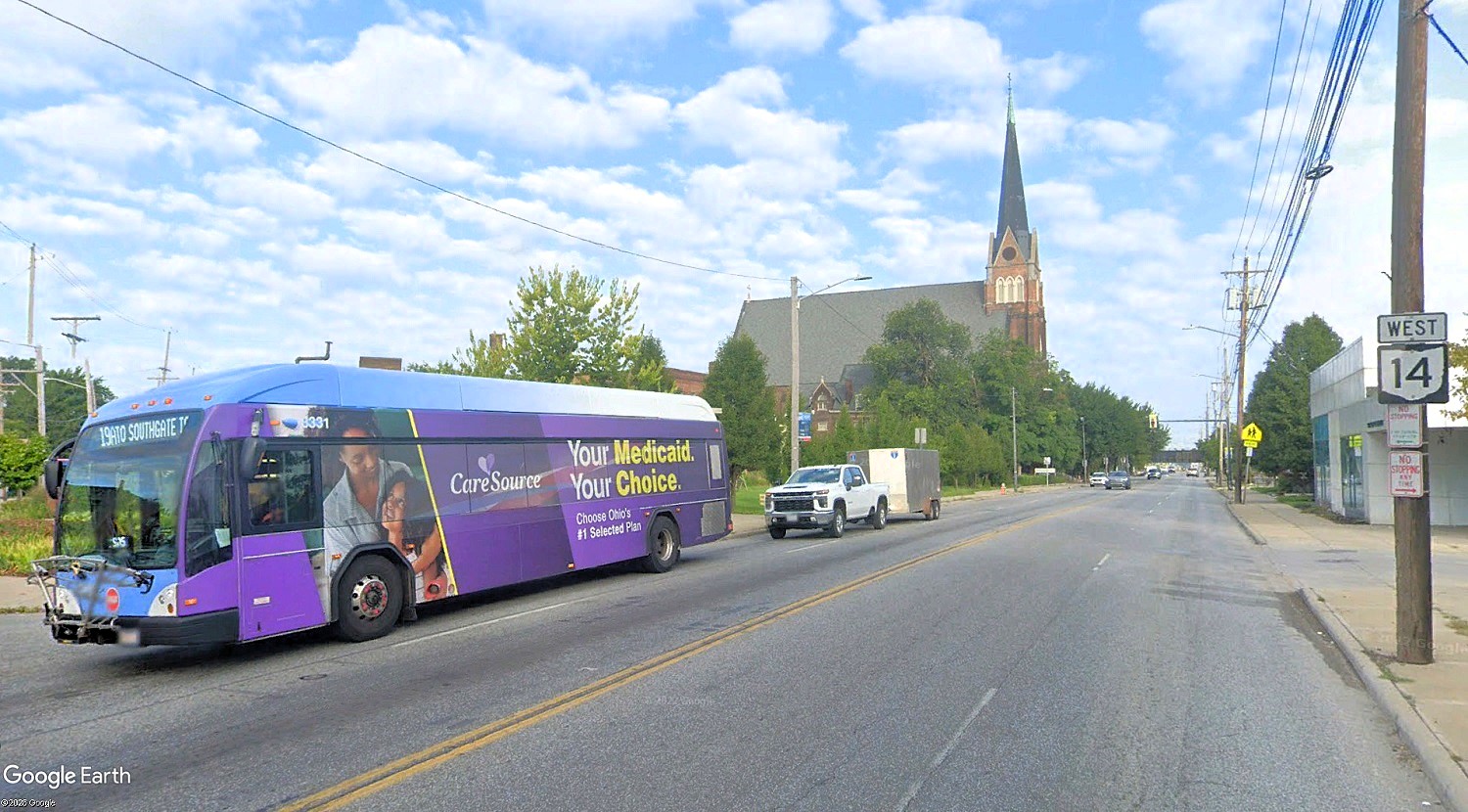
The No. 19A bus from downtown to Southgate Transit Center in Maple Heights stops on Broadway Avenue at Harvard Road after passing the 140-year-old Holy Name Roman Catholic Church. While much of Broadway’s urban fabric in Cleveland is gone, GCRTA and the city are hoping developing the Broadway corridor with bus rapid transit here will help revive it (Google). CLICK IMAGES TO ENLARGE THEM.
BRT construction could start in 2030
In 2008, the Greater Cleveland Regional Transit Authority’s (GCRTA) first bus rapid transit (BRT) line was the HealthLine east of downtown on Euclid Avenue to University Circle and East Cleveland.
Its next BRT was added in 2016, albeit a lightweight version offering bus-only lanes during rush hours only, west of downtown beyond the Shoreway on Clifton Boulevard into Lakewood.
In the next two years, GCRTA will start construction on the $75 million MetroHealth BRT southwest of downtown to Old Brooklyn, to speed up buses on several routes that funnel into the city on West 25th Street. The $75 million project just won $12 million in state funding to help it leverage a federal grant.
Similarly, Broadway Avenue is a funnel for five bus routes on Broadway and Miles avenues plus Turney Road into downtown. Those bus routes account for more than 7,100 daily riders despite serving a corridor that has lost a lot of its urban fabric in the Slavic Village neighborhood.
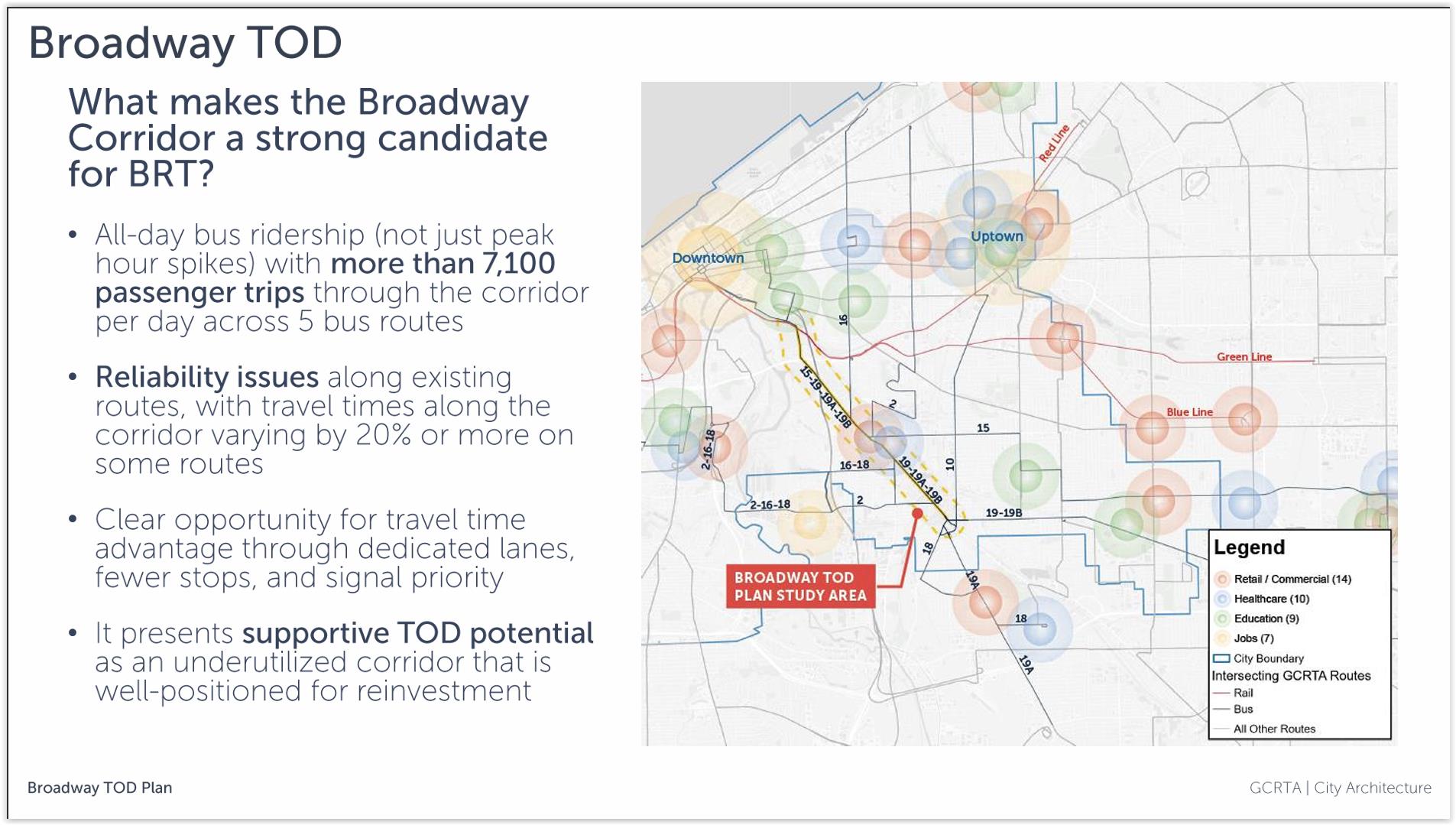
Many of the similar issues that affect the West 25th Street transit corridor also affect the Broadway corridor — areas of dangerously fast cars that endanger pedestrians and slow traffic that makes bus service unreliable, yet there is high transit ridership and a need to restore commercial districts and services for current and future residents (GCRTA/City Architecture).
GCRTA thinks it can draw more riders by making the buses a little faster and a lot more reliable by offering things like dedicated bus lanes on some sections of Broadway, signal priority for buses at intersections and fewer stops at better waiting areas.
That, combined with city incentives, could help restore some of that lost urbanity. By restoring the vibrancy of the corridor with transit investment can, in turn, help bring more ridership to transit, said Cleveland City Planning Director Calley Mersmann.
“As we were doing this project, we recognized that this is an historic streetcar corridor,” Mersmann said. “So historically all of the elements of a transit-oriented development (TOD) have been there along this corridor.”
“We’ve got density, mixed use, pedestrian orientation and scale and walkability,” she added. “So the bones of TOD really remain in this neighborhood and can provide a framework for bringing back the vibrancy and prosperity.”
Some sections of Broadway Avenue resemble a highway with straight, wide roadways that encourage speed, only to encounter denser commercial and mixed-use districts where pedestrians are needed (GCRTA/City Architecture).
Mersmann, the city, GCRTA and their consulting team laid out its plans for the Broadway Corridor at a meeting today of the City Landmarks Commission. The Landmarks Commission was the venue for presenting the plan because Broadway Avenue is a designated historic district.
The frequent bus service and potential for TOD — mixed uses offered in a dense, pedestrian friendly manner around transit stops — is what makes this a good BRT candidate corridor, said GCRTA Planning and Programming Director Maribeth Feke.
Its Broadway corridor plan was funded by a $432,000 federal grant awarded in 2022. And the planning work that was summarized in the presentation today to the Landmarks Commission was a result of that funding.
“This is really how we start our projects for bus rapid transit,” Feke said. “You’ll hear that Broadway is a priority corridor which means it has a high density of service from GCRTA.”
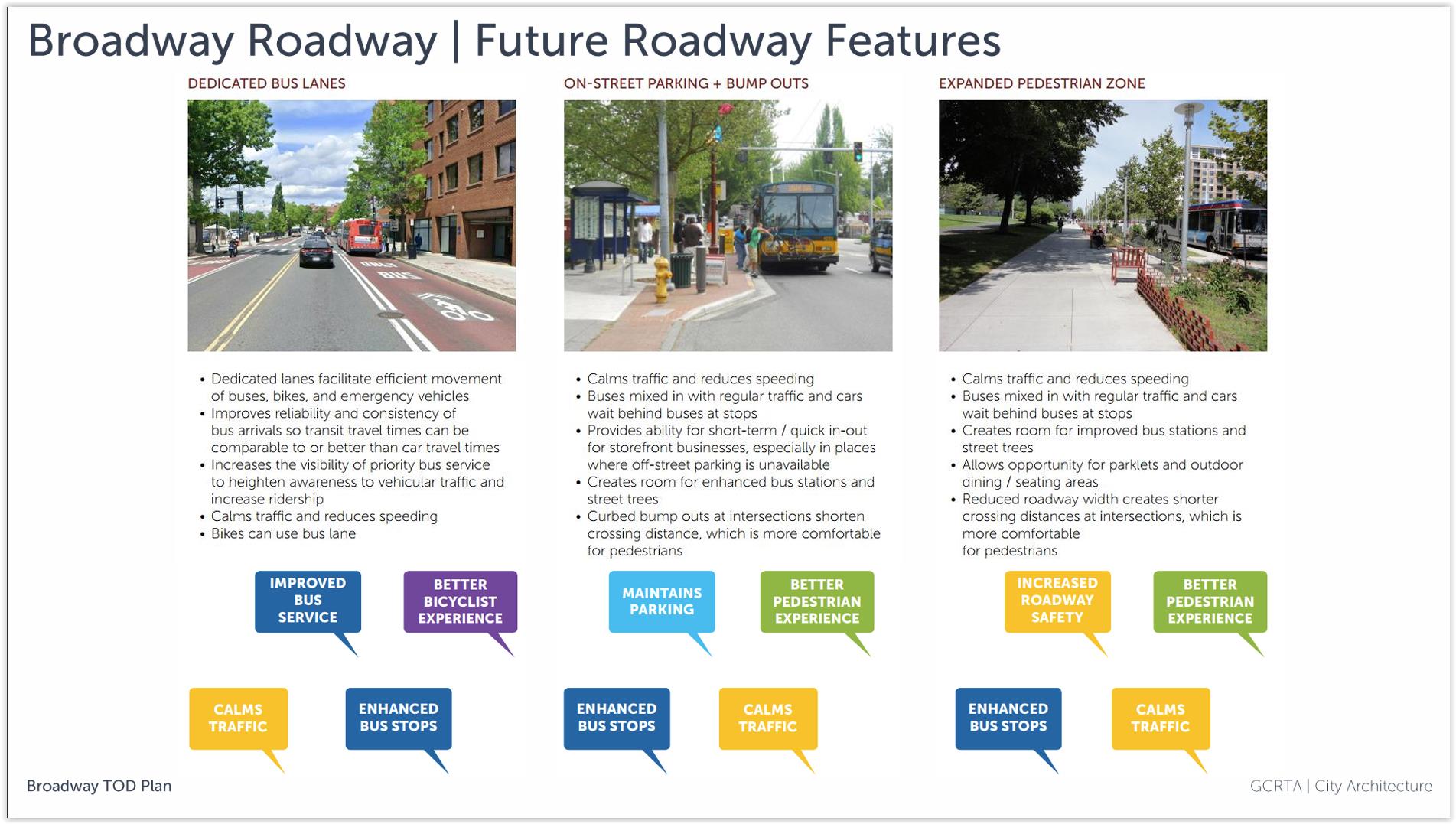
Potential new roadway features that could be added with the introduction of bus rapid transit infrastructure include dedicated bus lanes, enhanced pedestrian safety elements and improve public spaces along streets that make walking more enjoyable (GCRTA/City Architecture).
BRT on “25th Street started like this four years ago,” Feke explained. “It (West 25th) will go to construction we hope in the next two years. So this is just a progression of planning that we do on these corridors.”
But market analysis consultants Urban Partners of Philadelphia said the corridor faces an uphill climb to achieve more real estate investment. It noted home values are below replacement costs, investors (with many of them from out-of-state) dominate home ownership and rents are too low to sustain new multifamily developments.
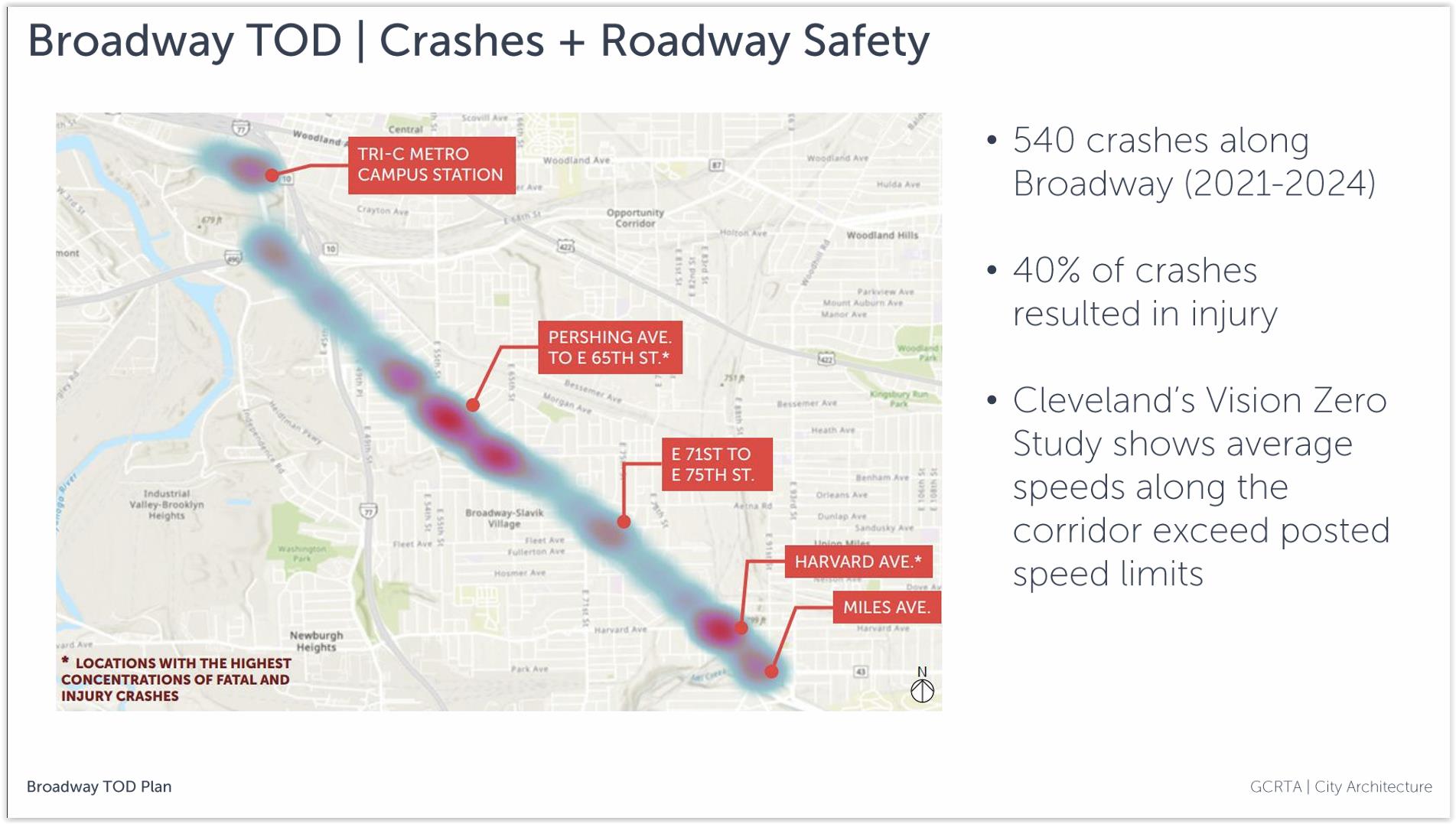
Another drawback to the Broadway corridor is it’s not safe for pedestrians — mostly because people are driving too fast on a wide, straight avenue. The city of Cleveland’s Vision Zero Study, which seeks to achieve zero traffic deaths in the city in a calendar year, shows average speeds along Broadway exceed posted speed limits.
From 2021-24, there were 540 vehicle crashes along the 3.75 miles of Broadway from Miles north to the Tri-C Metro Campus light-rail station at East 34th Street. Forty percent of those crashes resulted in injury. That points to the need to redesign the roadway to calm traffic, the Broadway planning team said.
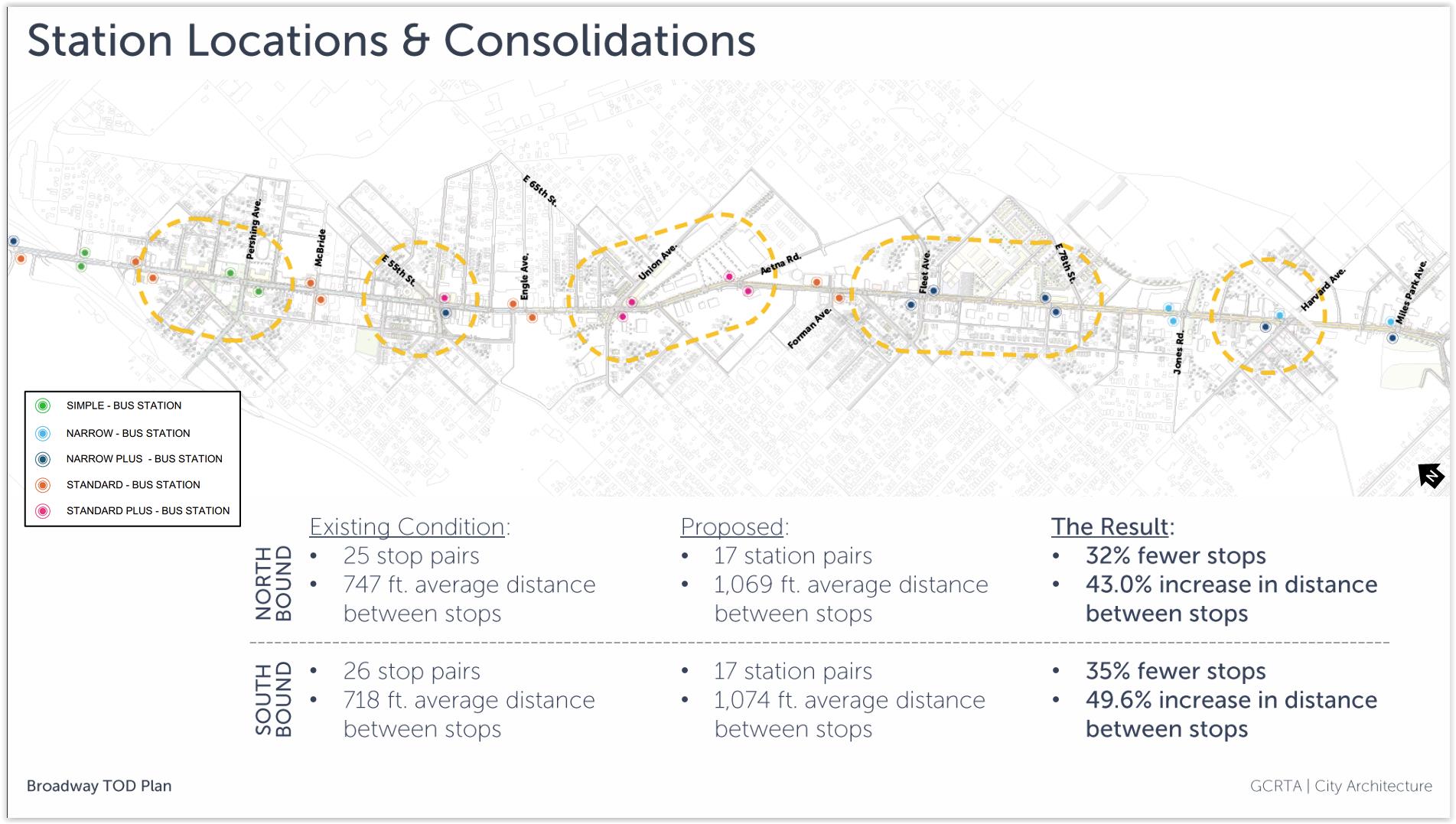
GCRTA says there are too many bus stops along Broadway Avenue from near the Tri-C Metro Campus Station at left to near the Miles Avenue intersection at right (GCRTA/City Architecture).
Team members said there are opportunities to start to redesign the roadway now with things like curb bump-outs at key intersections. And the city can landscape two to three curbside parking spaces at busier bus stops to help create more attractive transit waiting environments.
On the development side, constructing single-family homes to fill scattered vacant lots in neighborhoods can help change the dynamics of a community. So can publicly funded multifamily housing with income-restricted or supported apartments, like The Rising at 5115 Broadway, with 88 apartments over ground-floor retail.
“It (the Broadway plan) presents supportive TOD potential as an underutilized corridor that is well-positioned for reinvestment,” said Michelle Bandy-Zalatoris, director of planning and urban design at Cleveland-based City Architecture, who is a part of GCRTA’s Broadway BRT/TOD planning team.
A significant redevelopment at Broadway and East 55th Street, the heart of Slavic Village, has been in the works for several years. That redevelopment — called Village 55, offering a mix of historic rehab, demolition and new construction — is still alive and being pursued by Veda Capital LLC of Independence.
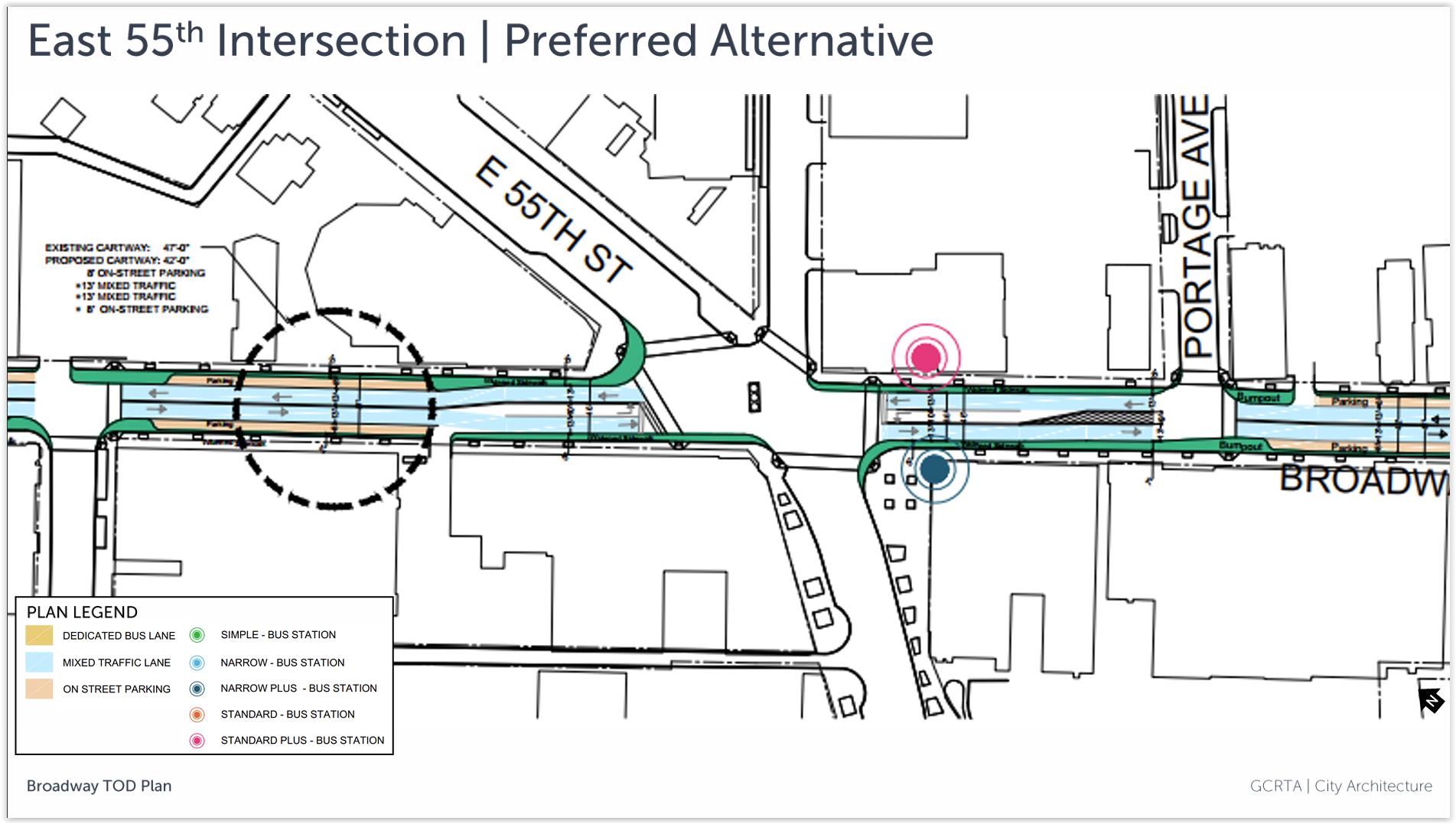
A conceptual design of how Broadway Avenue in the vicinity of East 55th Street could be redesigned with a narrowed street shown in green that offers larger sidewalks and areas for outdoor dining and other public spaces (GCRTA/City Architecture).
And since there are still some historic commercial districts that are relatively intact, albeit with many vacancies, assistance of neighborhood retailers to reuse existing storefronts can create a positive momentum for more.
Among the types of retail urged for the Broadway corridor are a coffee shop, ice cream shop, juice bar, and a limited number of full-service restaurants. Shops offering family clothing, women’s apparel and shoes were identified as needed.
Similarly, design team learned that residents wanted sporting goods, pet supplies, hobbies/toys/games, home furnishing and improvement, flooring and a nature/garden center retailers. Basically, just about everything is missing from this corridor which, if restored, would serve to make it a destination again.
As for next steps, GCRTA’s planning team said it will assemble materials to compete for Small Starts grant of about $50 million or less from the Federal Transit Administration and solicit partner letters of support for the federal funding application. The goal is start BRT construction in 2030.
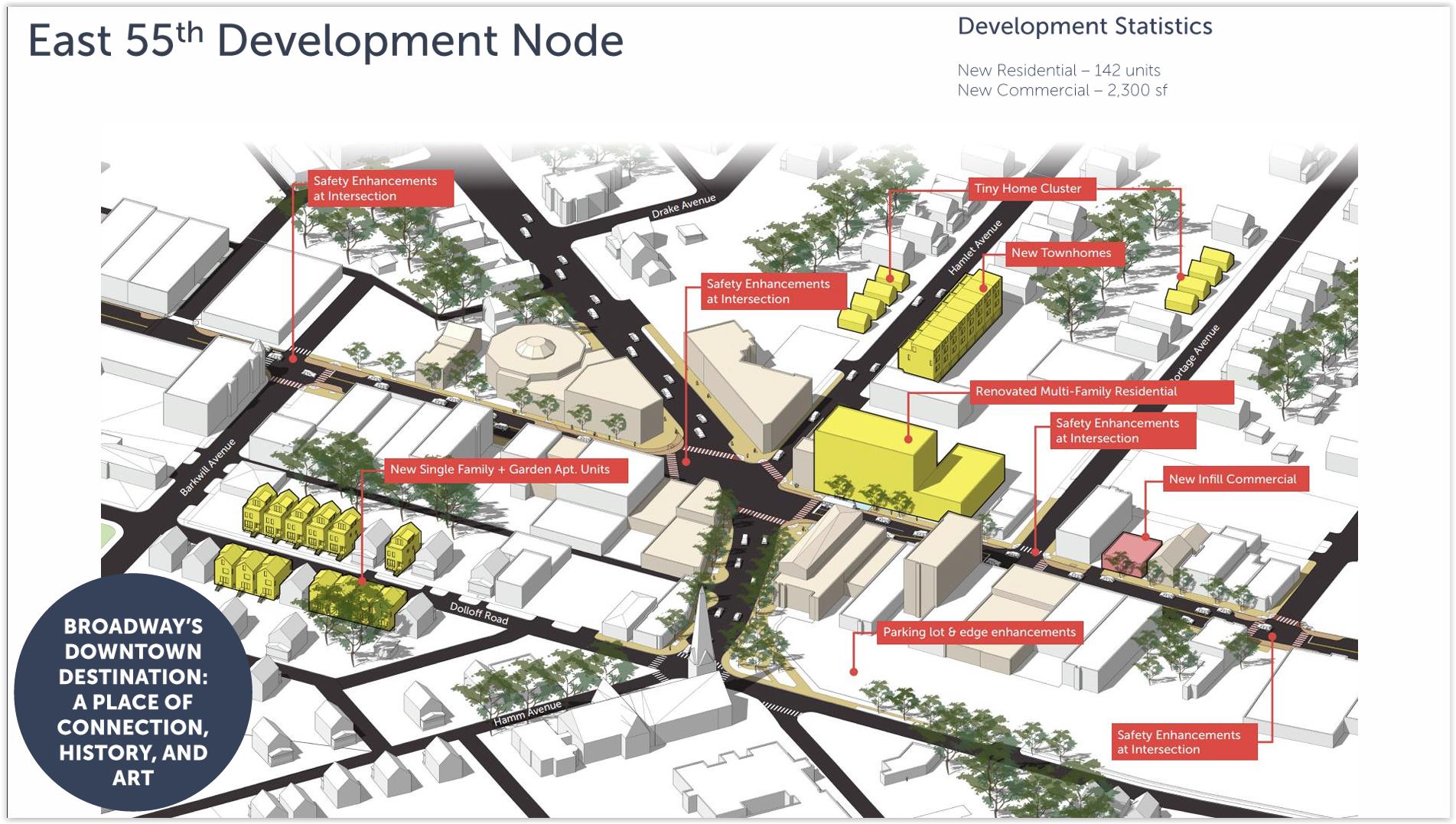
Redevelopment of the area around the Broadway-East 55th intersection to better support public transit and neighborhood retail, including the planned Village 55 development with a new, mixed-use building shown to the right of the intersection (GCRTA/City Architecture).
Planning will advance into detailed design and engineering with community input for the BRT and GCRTA will work in the meantime with the City of Cleveland and the Northeast Ohio Areawide Coordinating Agency to study and implement pedestrian experience improvements like better lighting, crosswalks and sidewalks, etc.
The city will stabilize historic buildings and assemble infill development sites with partners to increase developer interest and enhance recreational opportunity in the corridor. The city may also reposition Stella Walsh Recreation Center as a catalytic redevelopment site, the plan noted.
Stella Walsh Recreation Center is undergoing redevelopment as part of broader city efforts to upgrade community facilities. Recent investments include a newly renovated gym, weight room, and reconnection to a local facility for community engagement. The center may also host a new skating park.
END