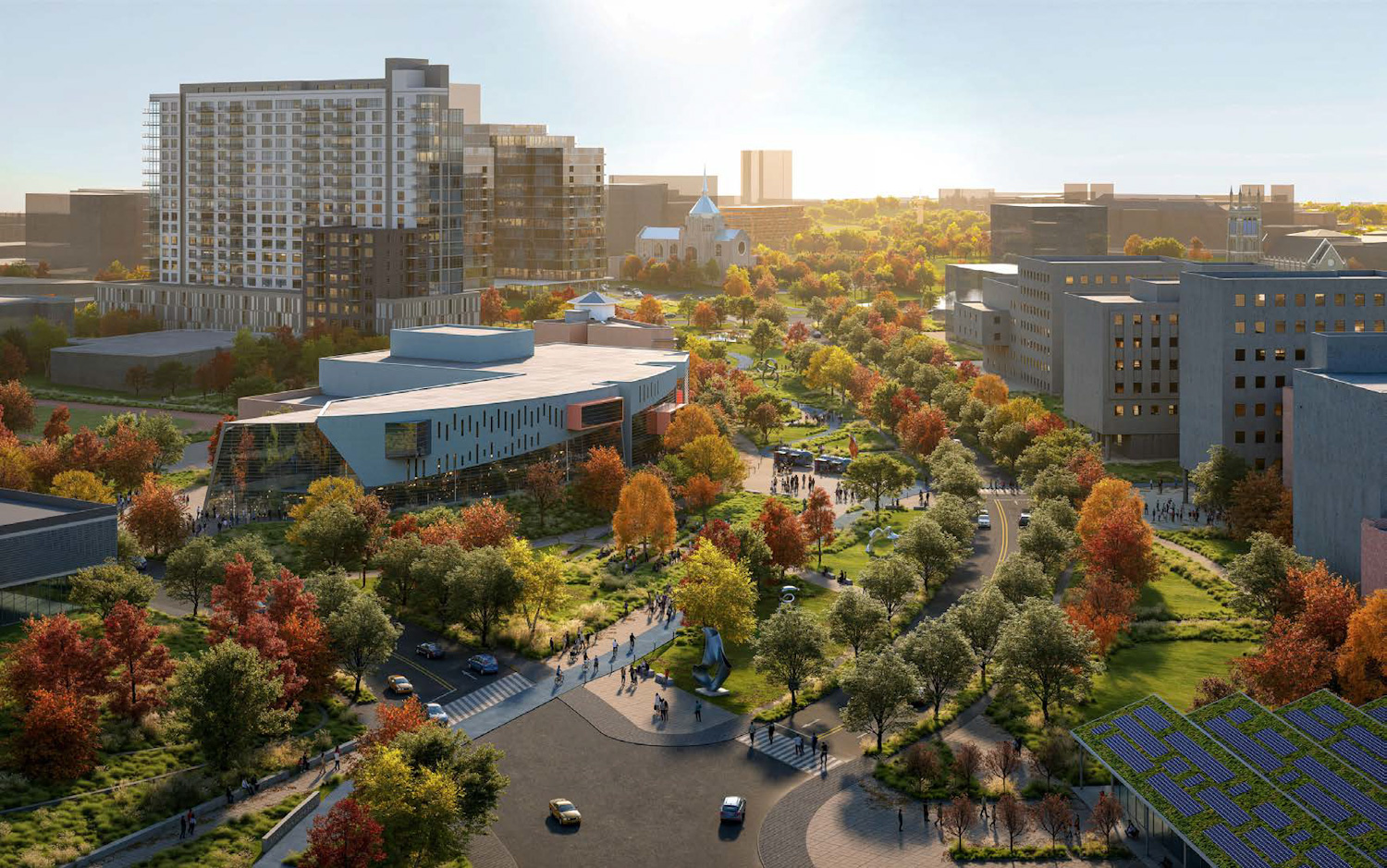
A conceptual rendering depicts a reworked South Rockefeller Park, including a proposed closure of Stearns Road and two-way conversion of MLK Jr. Drive (Sasaki). CLICK IMAGES TO ENLARGE THEM.
Connecting the Circle emphasizes five ‘Signature Moves’
On Friday, University Circle’s 10-year master plan for land use and public realm improvements won unanimous approval from City Planning Commission. The plan, titled Connecting the Circle, aims to transform the city’s second-largest employment center into a “Connected Civic Commons.”
Connecting the Circle consists of five Signature Moves: Euclid and the Cultural Corridor, East 105th Street, the Harrison Dillard Trail, South Rockefeller Park, and Wade Oval. Each move represents an opportunity to transform a corridor or green space through transportation and public realm improvements.
To develop the master plan, nonprofit University Circle Inc. (UCI) collaborated with Sasaki for planning and design, Toole Design Group for transportation and mobility, NelsonNygaard for its parking plan, and Third Space Action lab to create a community engagement strategy. UCI sought feedback from community and civic stakeholders throughout the planning planning process, with engagement still ongoing.
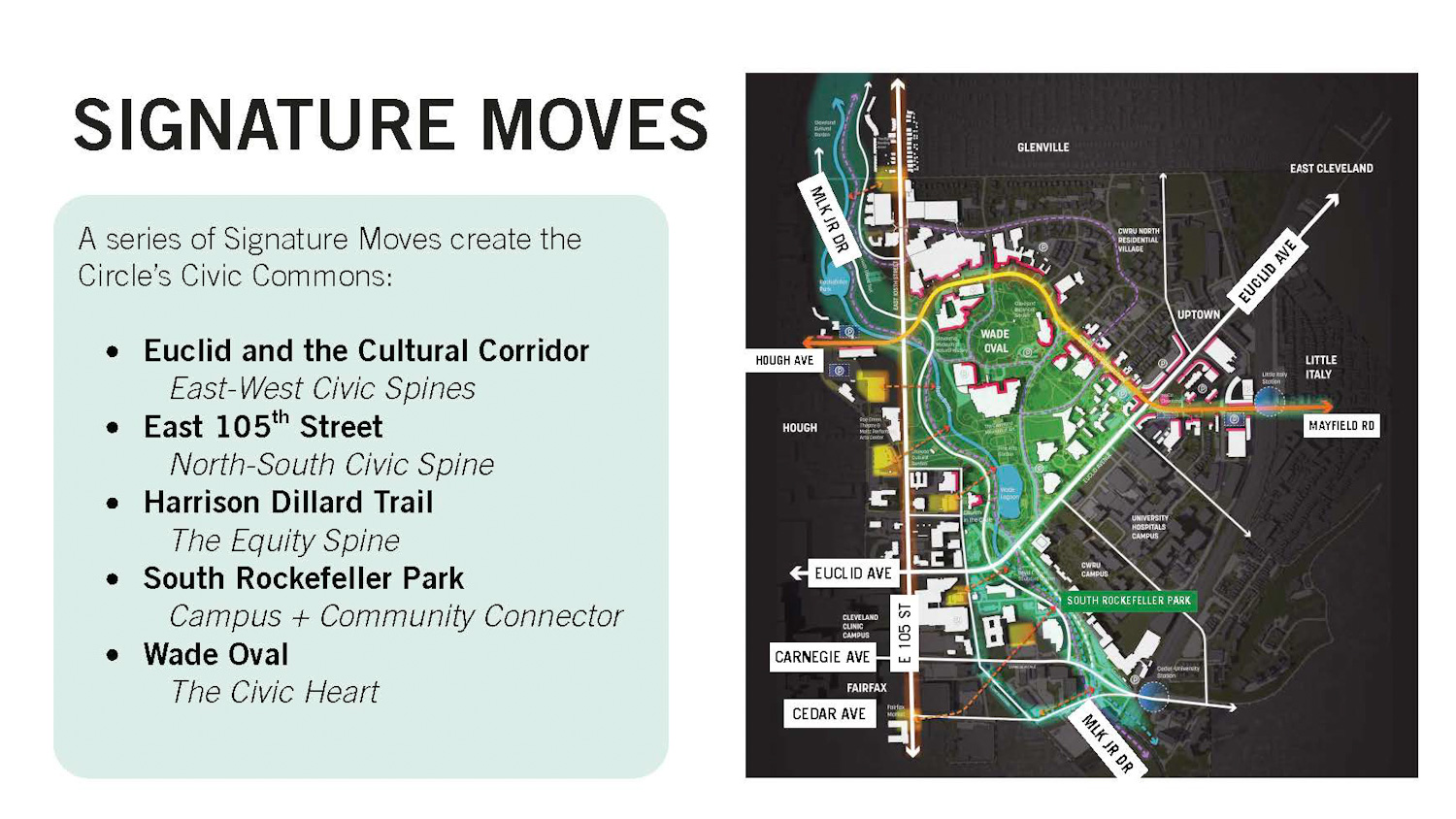
A presentation slide lays out Connecting the Circle’s five Signature Moves as they connect to the broader master plan (UCI).
The plan emphasizes the importance of civic institutions and philanthropy to University Circle’s importance, but recognizes the neighborhood’s past mistakes.
“Philanthropic investment and institutional growth have created a place with unmatched cultural resources,” stated Elise Yablonsky, a member of UCI’s Place Management team. However, she cautions that past development “Often prioritized institutional growth and access for cars over public space connectivity and neighborhood connectivity.”
Her team also acknowledges the erasure of local Black history, which the plan hopes to remedy by highlighting Black Clevelanders such as four-time Olympic gold medalist Harrison Dillard and entrepreneur Winston Willis — whose Jazz Temple hosted legends like Miles Davis and John Coltrane but closed in 1965, just three years after opening, due to a bombing that was never fully investigated.
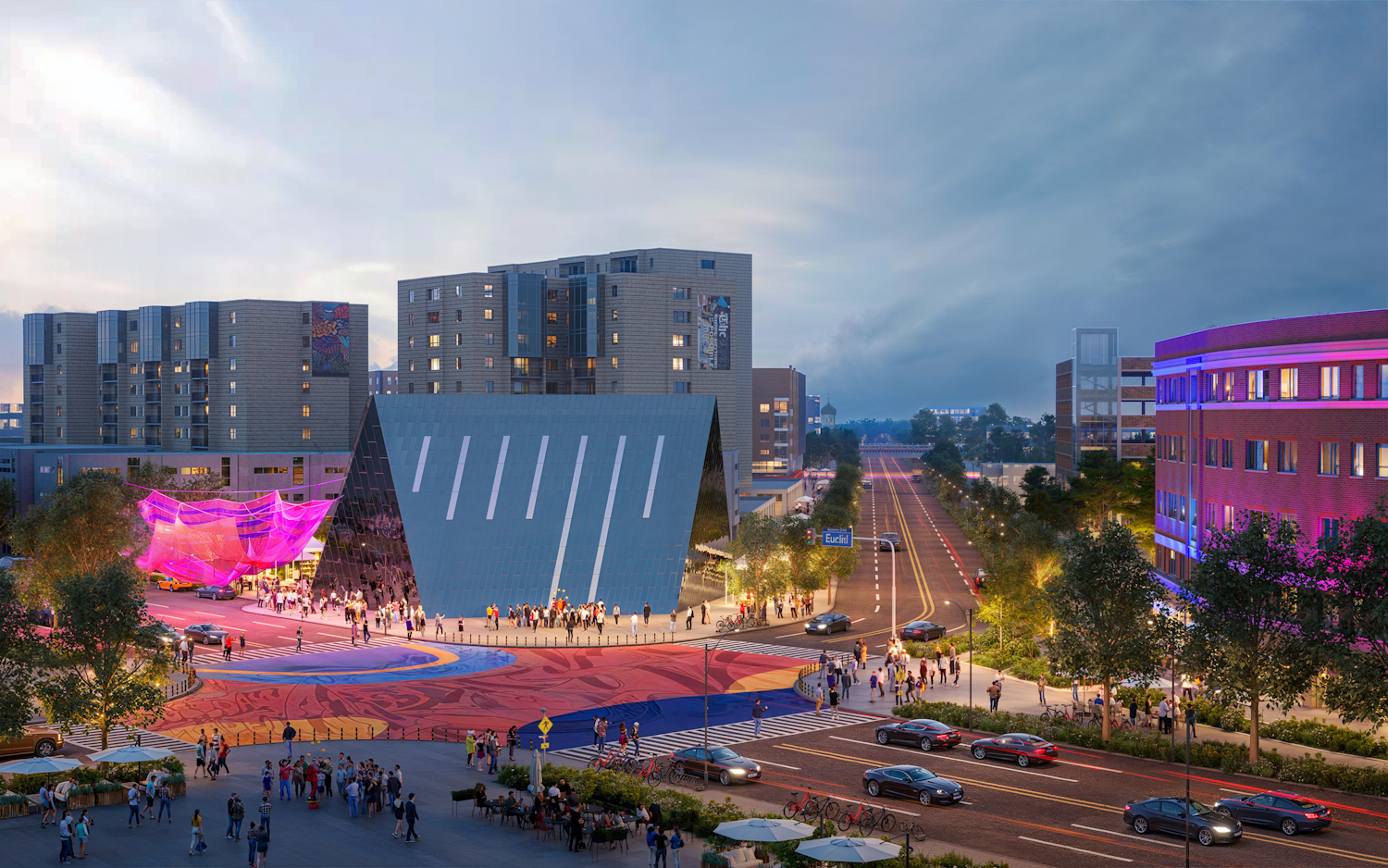
A conceptual rendering illustrates potential upgrades to the intersection of Euclid and Mayfield avenues. Winston Willis’ Jazz Temple once stood on the southeast side of Euclid, at the present location of the Museum of Contemporary Art at center-left (Sasaki).
During outreach efforts, community members expressed that navigating between institutions can be difficult or even dangerous. UCI hopes to fix that, improving safety and wayfinding on key corridors including East 105th Street, which connects neighboring Glenville and Fairfax, and an east-west “Cultural Corridor” stretching from Little Italy to Hough via Mayfield Road, Ford Drive, East Boulevard, Mt. Sinai Drive, and Hough Avenue.
Other plans include the permanent closure of Stearns Road and the two-way conversion of an adjacent section of Martin Luther King Jr. Drive to make way for an expanded South Rockefeller Park. The latter contains the southern end of the Harrison Dillard Trail — the city’s oldest bikeway — which would receive wayfinding improvements and a widened path under the master plan.
Before those proposals can move forward, a street network study and multi-modal wayfinding research are required.
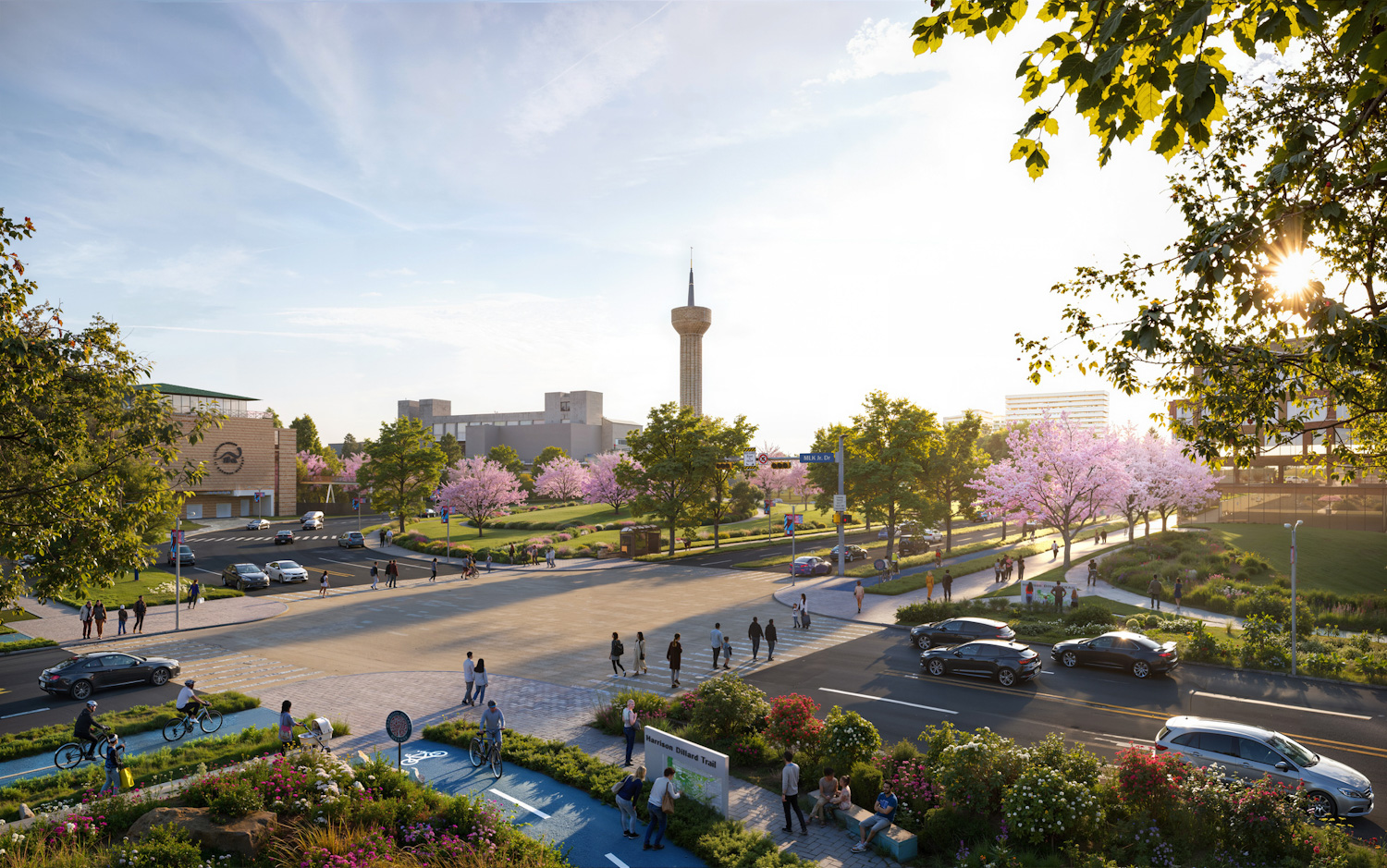
At the eastern edge of University Circle, an improved Harrison Dillard Trail would include better wayfinding and create a more welcoming entrance to the civic center (Sasaki).
At Friday’s meeting, Commissioner August Fluker noted the city’s challenge with creating public spaces that see passive, daily activity beyond programmed events. Other Planning Commission members shared concerns that neighbors may feel unwelcome in the district’s common spaces, which are often owned or managed by private organizations.
Connecting the Circle works to address issues like these and improve the vibrancy of public spaces such as UCI’s Wade Oval, which sits at the center of Cleveland’s Art Museum, Botanical Gardens, and Museum of Natural History. The master plan would add infrastructure improvements and amenities, including a multi-purpose pavilion and permanent restrooms, to support daily use by nearby residents, employees, and students.
Visitor activity would also be enhanced by targeting sites on East 105th Street and the Cultural Corridor for “supportive infill development,” including active ground floor uses such as retail.
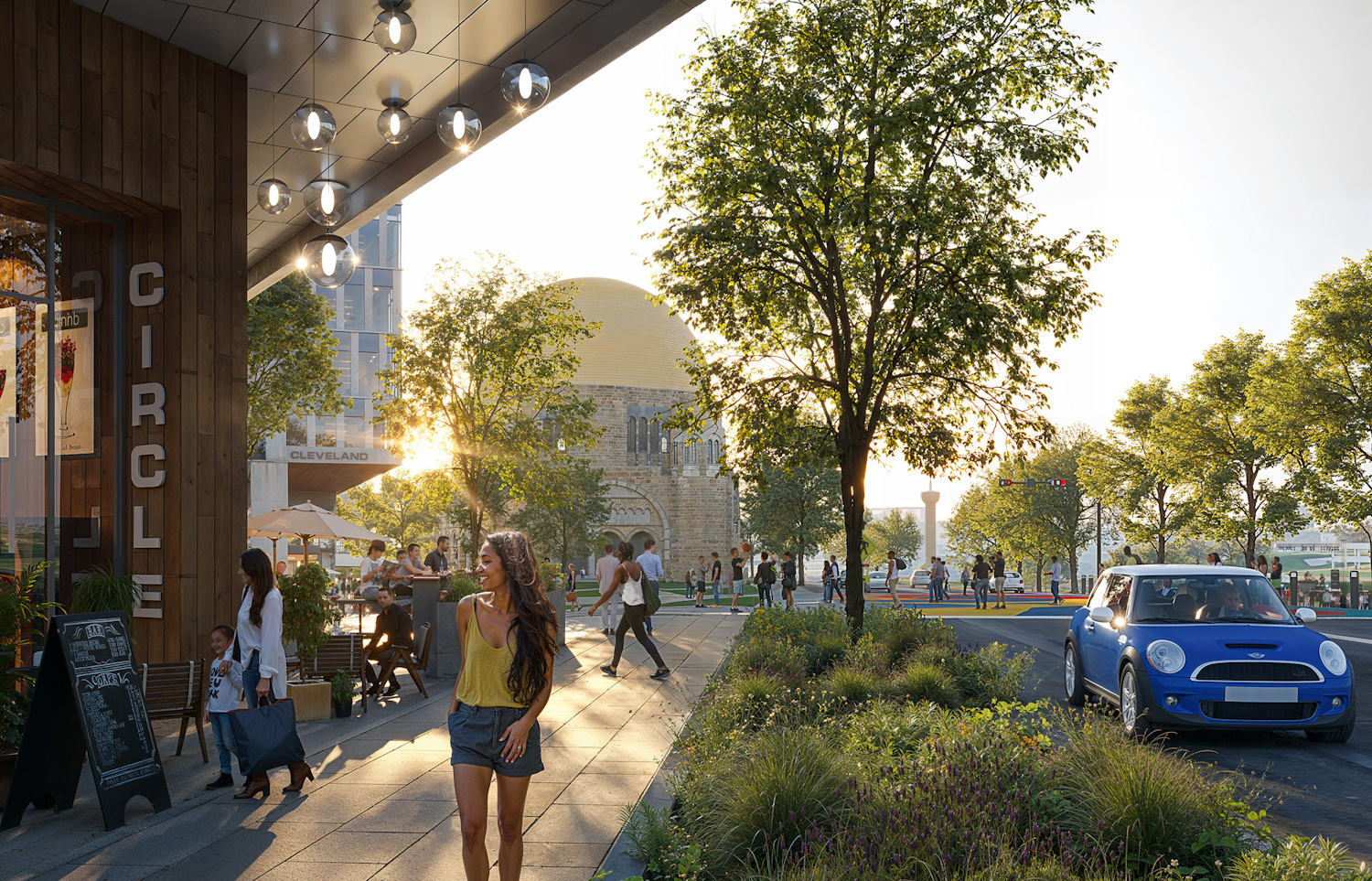
A rendering suggests new infill developments featuring active ground-floor uses on East 105th Street, immediately south of the Maltz Center for Performing Arts (Sasaki).
One example of this is already shaping up at the block of Stokes Boulevard north of Euclid Avenue, where the former MLK branch of the Cleveland Public Library will soon be demolished to make way for a new hotel tower as part of the Circle Square mixed-use development.
More information about UCI’s Connecting the Circle master plan is available on their Web site.
END